- This article for Vogelsang USA’s website highlights a new product used in wastewater treatment facilities.
- Link: https://www.vogelsang.info/en-us/news/news/article/article/rotacut-outperforms-grinders-for-digester-and-heat-exchanger-efficiency/
Rotacut Outperforms Grinders for Digester and Heat Exchanger Efficiency
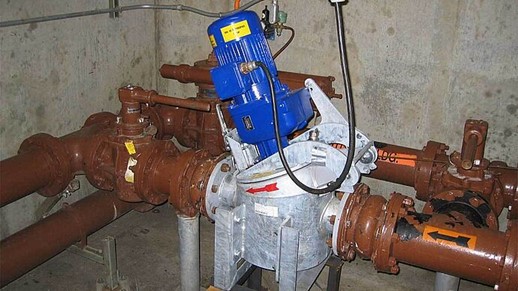
Digesters and heat exchangers rely on properly conditioned organic waste or feedstock for proper operation. As part of the conditioning, the particle size of the waste has a substantial effect on efficiency. To increase the efficiency of the digestion process, the optimized solid particle size needs to be consistent around 4-5mm (3/16”). This particle size is achieved with the use of solids reduction equipment.
Cut, Don’t Shred
Often, grinders are installed in feed lines going to the digester or recirculation lines. But this can often hinder rather than help the digestion process. One of the most prevalent problems with using a grinder for size reduction is the production of ragging – where solids and fibers that are shredded ball up after they pass through the grinder. This is due to grinders only having the capability to shred rather than cut, creating stringy, inconsistent output, especially when it comes to hair. Along with decreasing digester efficiency, this build-up requires costly cleanings to get things operating again.
Conversely, the Vogelsang RotaCut® macerator produces a more defined, smaller, and more consistent particle size with a “scissor-like cut.” This smaller particle size leads to faster and more efficient digestion. The chances of the solids and fibers balling up after the RotaCut are much less than a twin-shafted grinder. This is because a twin-shaft grinder doesn’t really cut any fibers or hair due to the design and mechanics of the technology. With a twin-shaft grinder, there is no contact between blades/rotors. A RotaCut automatically keeps constant pressure of the blades onto the cutting screen.
Digester Recirculation, Heat Exchanger
As new organic waste is added to the digester on a daily basis, it is usually colder than the actual temperature in the digester. The normal temperature of an anaerobic digester must be around 90-98 F (32-36 C), so the sludge is recirculated through a heat exchanger to maintain this desired temperature. Due to the design of most heat exchangers, long fibrous waste or rags balls will often lead to plugging. Once again, the RotaCut’s cutting action prevents this type of plugging from happening by ensuring waste is reduced to a particle size that easily passes through the system.
Smart Cutting Technology
In order to perform scissor-like cutting, the RotaCut cutter blades require constant pressure against the cutter screen. The blades are designed to wear over time but must wear evenly to achieve maximum life cycle. The Auto Cut Control (ACC®) monitors blade wear and automatically adjusts blade pressure against the cutting screen as the blades wear over time. The RotaCut also has an integrated heavy material separator, so any heavy solids are easily removed and kept out of the cutting system. The built-in Auto Reverse feature is how the RotaCut handles large objects, by which the unit automatically reverses the rotation of the blades until the object is cleared, reduced, and passed through the screen. Auto Reverse also engages at preset intervals, which keeps the blades wearing evenly. Other benefits of the RotaCut include easier in-line maintenance since the hinged lid can effortlessly be opened to access the cutter head.
 Kathleen Walder Portfolio